Welcome to another installment in our series about camera gear and accessories. (You can read my thoughts on lens hoods, UV filters, and camera straps, if you’re so inclined.) When it comes to gear that some people consider essential and some consider an unnecessary extra piece to juggle, the tripod is high on the list. Do you need one? If so, when? And if yes, how do you choose the one that's right for you from the dozens of options on the market?
Let's break down the answers to some of these often-asked questions.
Is a Tripod Necessary?
As with many other questions I get asked, my answer to this one is usually "it depends." Personally, I don't use a tripod all that often, but when the situation calls for it, it's an indispensable piece of gear. A tripod's purpose is to hold your camera still when you can't hold it still enough by hand to get a clean shot. The rule of thumb to remember is that the shutter speed you're using needs to be a larger number than the focal length of your lens. In other words, if you're using a 50mm lens, you will need a shutter speed of 1/50 or faster to get a clear image. (If this doesn't make any sense to you, join us for Photography 1.) If you don't follow this guideline, you risk blurry photos due to the camera moving while the shutter is open.
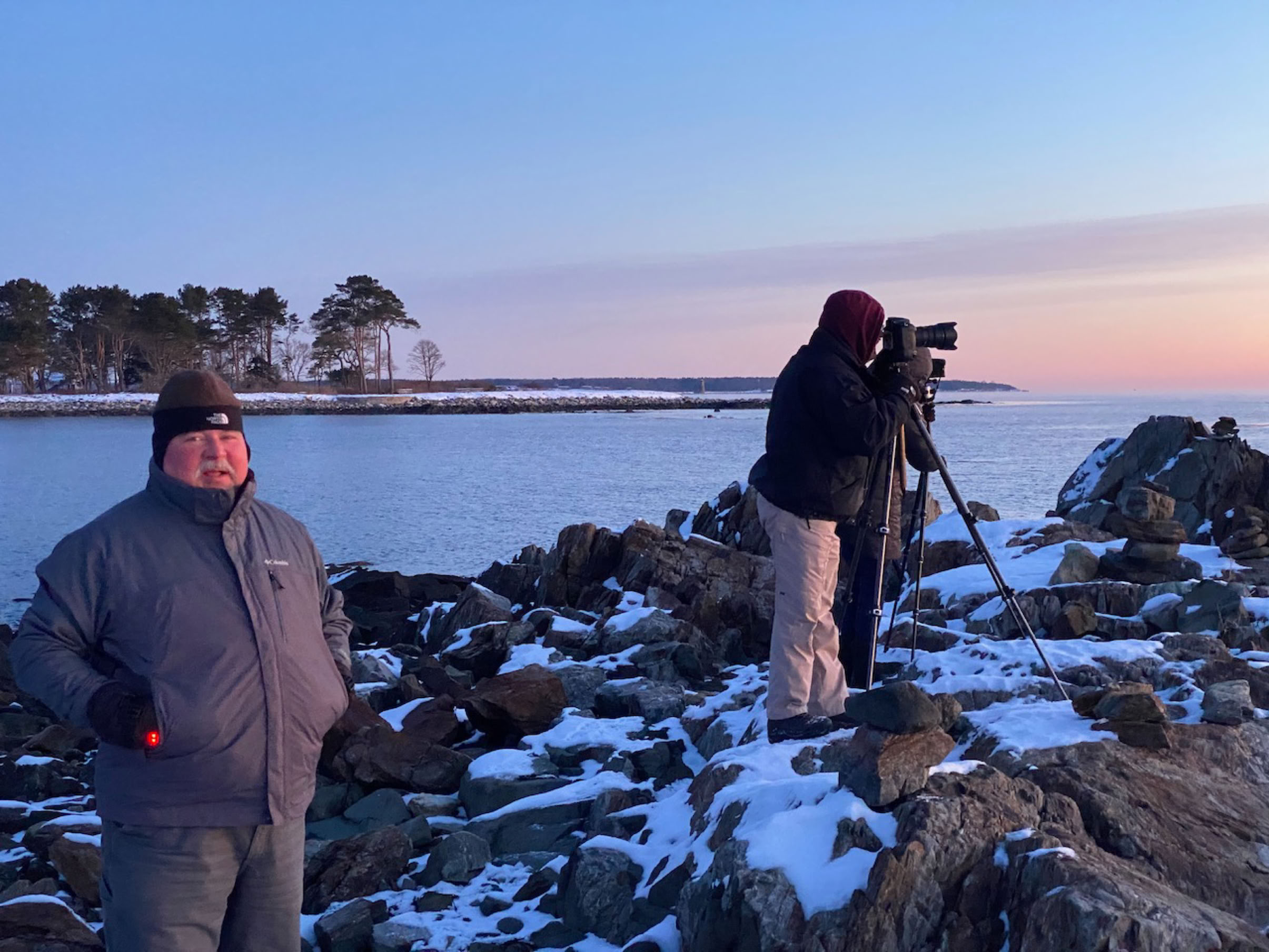
If you're photographing in conditions where you're using a slow shutter speed — think dusk, dawn, fireworks, night sky photography — a tripod is a must for images that aren't blurry. (Below, you can see a couple of our intrepid Photo Explorers— along with yours truly — putting their tripods to good use for a sunrise shoot.)
The Tripod System
It's worth being aware that a tripod system consists of the actual tripod and the head. The tripod is the three legs, of course, and the head is the part you attach the camera to. Some tripod systems come with both. The higher-end models usually don’t. If you have to buy a tripod and a head separately, it's good to make sure that they are of equal quality. Both pieces need to hold your camera steady to give you the results you're looking for.
Tripod Materials
Tripods can be made out of 3 different materials: steel, aluminum or carbon fiber.
Steel tripods are affordable and sturdy, but heavier.
Aluminum tripods are affordable and lightweight, but flex a little.
Carbon fiber tripods are lightweight and sturdy, but cost more.
Essentially you get to choose from lightness, stiffness and affordability. Pick two.
Tripod Construction
Tripods collapse to make them more portable. Many tripods consist of either 3, 4 or 5 segments. Segments attach to each other via some type of knuckle. While different knuckle designs provide different stiffness, generally speaking, the fewer segments your tripod has, the stiffer it will be. The more segments a tripod has, the more compactly it will fold together. There's that portability vs. sturdiness conundrum again. A travel tripod that folds up very small will be ultra-portable, but every additional set of segments means an additional set of knuckles, and those junctions are a place where there can be flexing, which could make your tripod more prone to movement.
Speaking of knuckles, there are different types, and that can make a difference, too. Many tripods come with a clip-style knuckle that pinches around the leg segment and holds it at a few spots. I prefer a round choke-style knuckle that grips the leg all the way around for a sturdier hold and less potential for movement.
How to Choose the Right Tripod
As I said, I've found for myself — and for the majority of my students — that a tripod is something I need fairly infrequently. You might think that means I'd suggest a lightweight and inexpensive option - who wants to shell out the cash for something that might only be used a few times a year, right?
Actually, it's just the opposite. If you buy a good enough tripod, you'll only have to buy one in your entire life. Just like the camera itself or a high-quality lens, it should be thought of as an investment. It's worth spending a bit more for something that will last a lifetime and perform well when you need it. It is beyond frustrating to return from a shoot excited to see what you captured only to discover that all your photos are blurry because your tripod flexed. To me, it's worth the upfront outlay to have a tripod I trust completely. Some photo opportunities are truly once in a lifetime, and missing them because you chose to go with cheaper equipment is no savings at all.