
There's a wall in every camera store that I think about more than I should. It's usually near the register, sometimes behind glass, and it holds rows of filters arranged by size and color like an optometrist's tray. Orange, red, yellow, green, and then the clear ones, each in its own little case, each with a purpose printed on the label in language designed to make you feel like you can't leave without at least two of them.
I want to tell you about that wall, because almost everything on it is a relic, and the one filter the salesperson pushes hardest is the one that will actually make your photos worse.
The colored filters came first, and they earned their place. If you were shooting black and white film, each color told the emulsion how to render a specific tone in grayscale. An orange filter could take a pale blue sky and drag it down to something moody and dark. A red filter turned white clouds into bright punches against a sky gone almost black, the kind of contrast that made Ansel Adams prints feel like they were carved rather than printed. Green opened up foliage, kept trees and grass from sinking into a muddy sameness where every leaf looked like every other leaf.
Beautiful system. Elegant, even, in the way it forced the photographer to decide before pressing the shutter how the world should translate into shades of gray. But every bit of that translation now lives inside your digital camera, handled by the sensor and the software with a degree of precision and flexibility that a piece of tinted glass could never match. You can do it all in post-processing, with sliders, with control over individual color channels, with the ability to change your mind after the fact instead of committing to a filter choice before the moment passes.
So the colored wall is a museum. Nobody bothered to take the exhibit down, but you can walk past it without losing a thing.
Here's where the store earns its money, though, and this is the part that bothers me.
Right next to the colored filters, sometimes in its own little display with a handwritten recommendation card, sits the UV filter. Clear glass, metal ring, nothing fancy to look at. And the salesperson, who is usually a genuinely nice person trying to help, will tell you that this filter should be the very first accessory you buy. They'll say it protects your lens. They might mention ultraviolet light, haze in the atmosphere, a slight improvement in image clarity. All of it sounds careful and responsible and smart.
And almost none of it is true.
Your digital camera cannot see ultraviolet light in any meaningful way. The sensor is built for the visible spectrum, and most cameras ship with an infrared-blocking filter already installed over the sensor to keep things tuned precisely to the range your eyes operate in. UV filtration on the front of the lens is addressing a problem that existed for film and simply does not exist for you. The glass does nothing for your image. Nothing.
"But it protects the lens." That's the fallback, and it's the one that sticks, because who doesn't want to protect a thousand-dollar lens with a thirty-dollar piece of glass? Sounds like the cheapest insurance you could buy.
Except your lens already came with protection, and it's better at the job than any filter. The hood. That chunky piece of plastic or rubber that shipped in the box and maybe never made it onto the camera because it looked strange or felt bulky. That hood should live on your lens every single day, because it does two things that a UV filter cannot do and one thing the UV filter actively undoes.
It absorbs physical contact. Bumps, brushes, fingers reaching past the camera in a bag. The hood extends beyond the front element and takes the hit first, which is exactly the kind of protection that matters in real life, not a thin disc of exposed glass sitting flush with the front of the lens where a bump can shatter it and drive the shards into the very element it was supposed to protect.
And it controls light. The hood is shaped, specifically shaped for the focal length of your lens, to shade the front glass surface from stray light striking it at steep angles. That stray light is what causes lens flare, those washed-out streaks and that milky loss of contrast that flatten your photos and make colors look tired. The hood blocks it. Contrast comes up. Colors get punch. The image cleans up in a way that no amount of post-processing can fully replicate, because the flare was baked into the capture.
Now think about what happens when you screw a UV filter onto the front of that lens. You've moved the first glass surface forward. Out past the hood's shade line. Closer to the light source. You've placed a new, unshaded piece of glass exactly where stray light can hit it, and every photon that bounces off that filter is flare that the hood was designed to prevent and now cannot reach. The filter you bought to protect your image quality is actively degrading it while doing a worse job of physical protection than the accessory your lens was shipped with.
I find that genuinely maddening.
Leave the UV filter on the rack. Put your hood on. Done.
So after all of that, what goes in the bag? Two filters. Possibly.
The polarizer is the one you'll reach for on any bright day. You screw it onto the front of the lens and rotate a ring, and what happens feels unreasonable for the price. Greens go saturated and alive in a way that even good light doesn't quite produce on its own. Blues deepen until the sky looks like it did in your memory of the day, not the washed-out version your camera recorded without help. Reflections on water and glass either pop into sharp detail or vanish entirely, depending on the angle you choose, giving you a kind of control over the scene that no amount of editing can replicate because the filter is changing the light before it enters the lens, not after.
Forty dollars, maybe fifty, for something that genuinely alters what the camera can see. It's the one filter purchase I've never once regretted.
One limitation, though, and it's an annoying one. Polarizers work beautifully on standard and telephoto lenses, where the angle of view is narrow enough that the polarization spreads evenly across the frame and everything benefits. On wide-angle lenses, the story gets uneven. The center of the sky polarizes nicely, deepens the way you'd hope, but the corners lighten up and lose saturation, as if the effect faded out before reaching the edges of the frame. It's not catastrophic. The filter is still doing something useful. But once you see the inconsistency, and you will see it, it becomes impossible to ignore. The irony is that wide-angle lenses are the ones you'd most want to polarize, because that's what you're shooting landscapes with, and landscapes are where richer skies and deeper color matter most.
Use it anyway. The center of the frame is often the center of the image, and the improvement there is real. Just know the edges won't match.
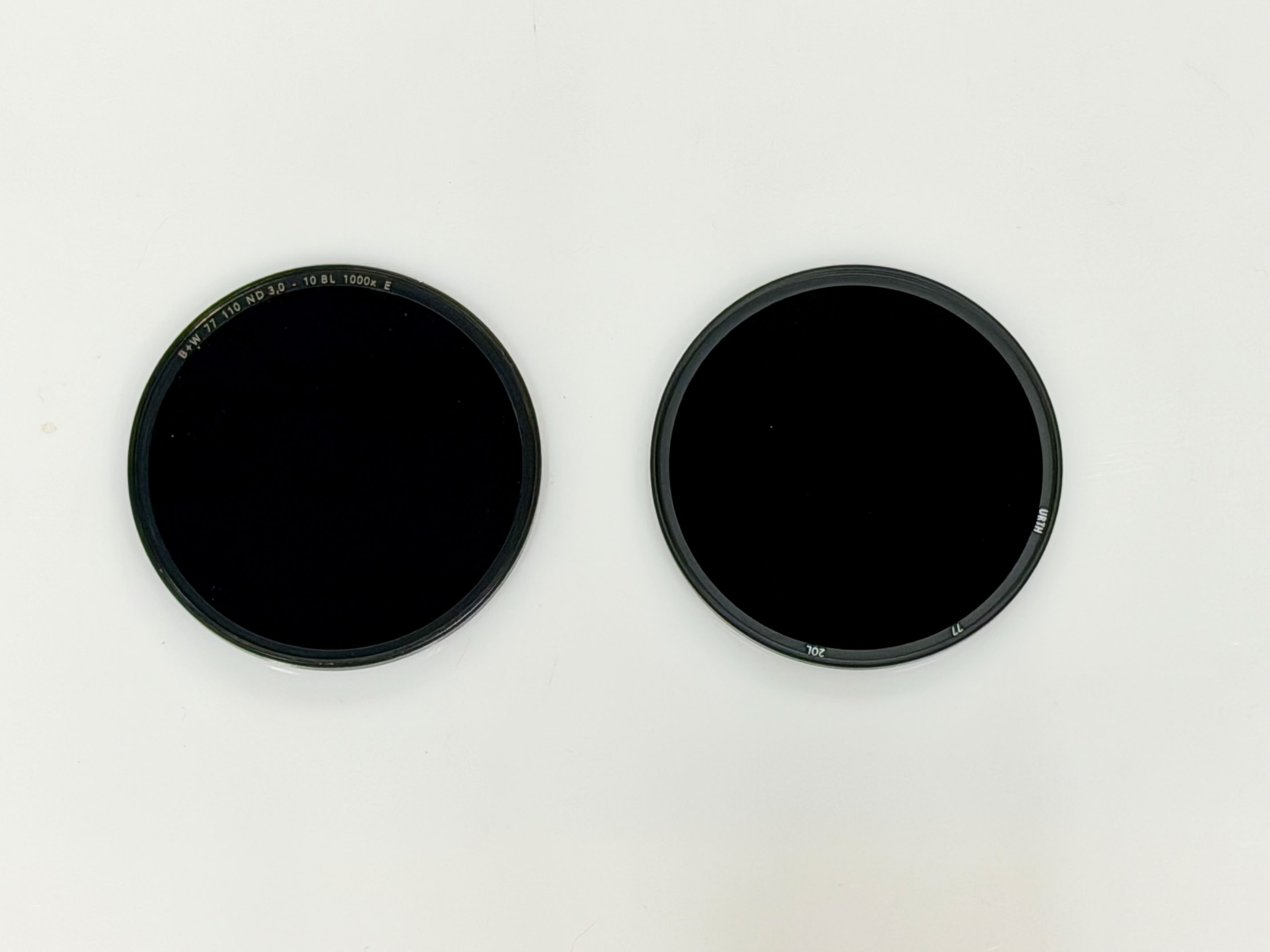
The second filter is the neutral density, the ND, and this one lives in the bag for a specific purpose that nothing else can handle. It blocks light. All of it, evenly, without changing color. Think of it as sunglasses for the lens. You put it on when you want a long exposure in conditions where the light is too bright to allow one, which is to say, outdoors, in daylight, which is exactly when the most dramatic long-exposure subjects present themselves. Waterfalls that turn from crashing water into flowing silk. Ocean waves that blur across rocks and sand until the surface looks like fog rolling over stone. The effect requires the shutter to stay open for seconds, sometimes thirty seconds or more, and without an ND filter cutting the light down, all you get is a white rectangle.
Now I need to save you some money, because I've already spent it and there's no reason for both of us to learn this the hard way.
Adjustable ND filters exist, and they sound perfect. One filter, a rotating ring, dial in however much light reduction you want. The problem is that the density is not even across the glass. You get banding, darker zones bleeding into lighter ones, and the pattern changes unpredictably when you adjust the ring. I tried them because I wanted the convenience to be real. It wasn't. The results were uneven in ways I couldn't correct in post, and the inconsistency meant I could never trust the filter on a shot that mattered. They went in a drawer.
Filter sets are a different kind of trap. A 2-stop, a 4-stop, and a 10-stop, packaged together in a zippered case that feels like a smart investment. But the truth about neutral density is binary. Either you need to block a massive amount of light because you're dragging a shutter open in bright sun, in which case the 10-stop is the tool, or you don't need to block light at all. There is no useful middle. The 2-stop and the 4-stop have never come off the bench. They sit in my case like understudies who will never get the call.
Buy a single 10-stop ND from a reputable brand. Skip the set.
A polarizer for the days when color deserves to look the way you remember it. A 10-stop ND for the rare occasions when you want to bend time. A lens hood that never comes off. The rest of that wall is a store's margin dressed up as your necessity, and thirty years of film advice still echoing in a digital world that moved on without updating the script.
Two filters. A hood. A lighter bag.